Modern Physics · Undergraduate Engineering
Particle in a One-Dimensional Infinite Potential Well
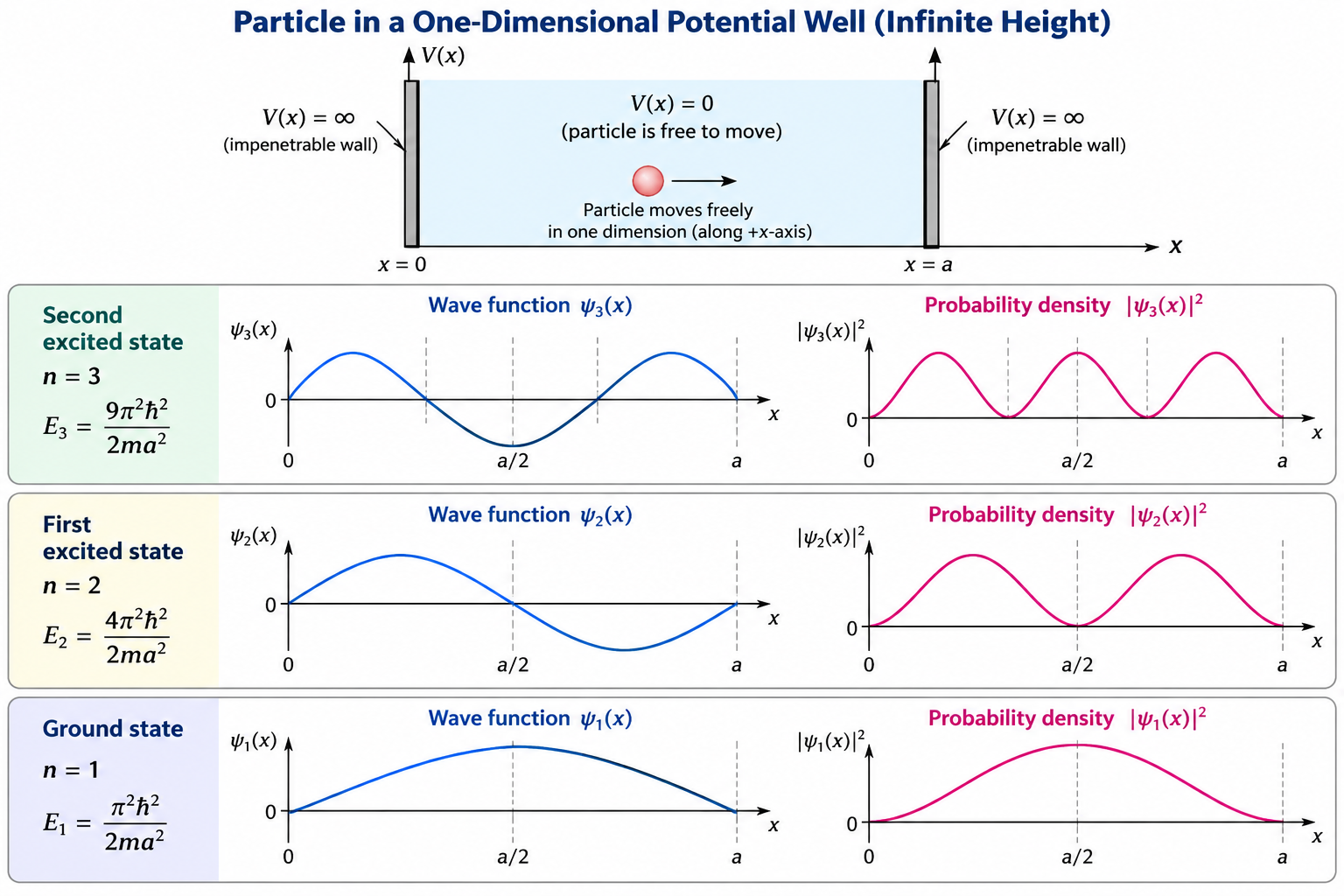
A particle is confined between two perfectly impenetrable walls separated by a distance a. This simple model shows how confinement leads to discrete energy levels and characteristic wave functions.
1. Physical picture: the particle in a box
Inside the well
For \(0\lt x\lt a\), the potential energy is defined as \(V(x)=0\). The particle is free of potential-energy forces in this region in the idealized model.
At and outside the walls
The ideal walls have \(V(x)=\infty\) for \(x\leq 0\) and \(x\geq a\). The particle cannot exist beyond the walls, so the wave function must vanish at both boundaries.
2. Boundary conditions and allowed states
For a particle of mass m in the well, the time-independent Schrödinger equation inside the box is
Impenetrable walls require \(\psi(0)=0\) and \(\psi(a)=0\). Only standing waves that fit an integer number of half-wavelengths inside the box satisfy both conditions:
The associated quantized energies are
Here, \(\hbar=\frac{h}{2\pi}\). The energy is proportional to \(n^2\) and inversely proportional to the square of the box width, \(a^2\). The ground-state energy is non-zero: confinement does not permit a zero-energy stationary state.
3. Explore the first three stationary states
Each row pairs the wave function with its probability density. The two plots share the same horizontal coordinate and the probability-density baseline is aligned with the wave function’s \(\psi=0\) axis.
The orange marker is a synchronized teaching aid that helps compare the same x-position in both plots. It is not a literal trajectory, and the probability density of a stationary eigenstate does not travel with the marker.
4. How to interpret the plots
- Wave function \(\psi_n(x)\): may be positive or negative; its sign is an amplitude, not a negative probability.
- Probability density \(|\psi_n(x)|^2\): is always non-negative. The probability of finding the particle between x and x + dx is approximately \(|\psi_n(x)|^2\,dx\).
- Nodes: points where \(\psi_n(x)=0\). The state n has n − 1 internal nodes; all states also vanish at the two walls.
- Ground state \(n=1\): one positive lobe and no internal node.
- First excited state \(n=2\): two lobes of opposite wave-function sign and one internal node at a/2.
- Second excited state \(n=3\): three lobes and two internal nodes at a/3 and \(\frac{2a}{3}\).
5. Check your understanding
- Why must the wave function be zero at x = 0 and x = a?
- How does the energy of n = 3 compare with the ground-state energy E₁?
- Where is the internal node of the first excited state?
- Why can probability density never be negative even though the wave function can?
Show concise answers
- The infinite walls exclude the particle from the outside region, requiring the boundary values \(\psi(0)=\psi(a)=0\).
- \(E_3=3^2E_1=9E_1\).
- At \(x=\frac{a}{2}\).
- Because \(|\psi|^2\) is the squared magnitude of the wave function.